The Hidden Cost of Running Everything Yourself
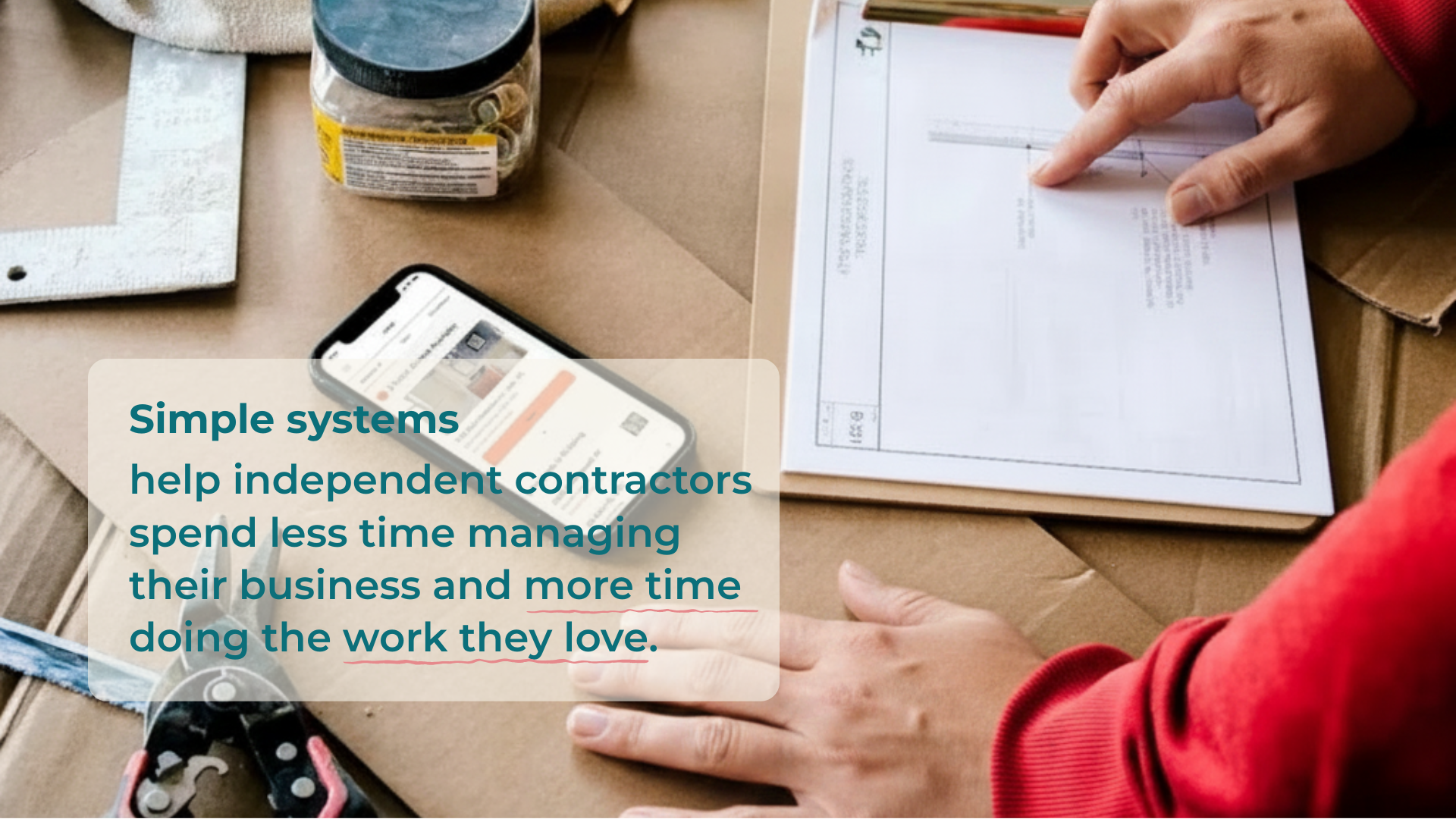
How Simple business systems help independent contractors spend less time managing the business and more time doing the work they love
Most independent contractors start their business because they love their trade.
They know how to solve problems. They take pride in their craftsmanship and the reputation they have built with their customers.
They didn’t start their business because they wanted to spend their evenings doing paperwork, chasing down invoices, or trying to keep track of everything happening in their head.
But as the business grows, more and more of your time gets pulled away from the field work.
Customer calls. Estimates. Scheduling. Material orders. Invoices. Follow-ups. Questions that need answers.
Those things are part of owning a business.
The challenge is that even a one-person business has a lot of moving parts.
Over time, the business can start requiring just as much attention off the job site as it does in the field.
As the business grows, the way you’ve always handled things may not work as well as it once did.
When Everything Runs Through You
In the beginning, keeping track of everything yourself works.
You know your customers. You know your jobs. You know what was discussed, what needs to happen next, and where things stand.
But as the business grows, so do the details.
A customer calls while you are on another job.
A material delivery changes.
An estimate needs a follow-up.
A payment is waiting.
A schedule changes.
Each thing seems manageable by itself.
That’s where a little structure can take some of the weight off your shoulders.
Systems Don’t Have to Be Complicated
When people hear the word “systems,” they often think about complicated processes or software.
That’s not what a system has to be.
For an independent contractor, a system is simply a consistent way of handling something that happens repeatedly.
It might be:
- A process for responding to new customer inquiries
- A way to keep job details organized and easy to find
- A checklist for starting and closing out jobs
- A routine for estimates, invoices, and follow-ups
The purpose isn’t to add more work.
It’s to put systems in place to make the business run smoothly and more efficiently. When systems are in place, you get time back to spend it where you want to rather than where you have to.
Where Independent Contractors Usually Feel Bogged Down
The pressure usually isn’t coming from the work itself. It comes from everything surrounding the work.
It shows up when customer conversations are spread across texts and emails, when estimates need follow-up, when job details are hard to find, or when invoices and paperwork get pushed to the end of the day.
The business grew. The way you’ve been running it didn’t.
Most of the time, the answer isn’t working longer hours. It’s finding the handful of places where the day keeps getting interrupted, information gets lost, or everything depends on you remembering things.
A Carpenter’s Lesson
I grew up watching my dad build his business as a carpenter.
He was proud of his work. He cared about his customers. He valued the independence of running his own business and doing things his way.
He didn’t want a large company with multiple crews.
He wanted to do quality work and take care of people.
But like many independent contractors, he carried a lot of the business himself.
He managed the work, the customers, and all the details of running his business.
Over time, putting a simple routine around the stuff that kept coming up helped make the business easier to manage.
It didn’t change the quality of his work or the way he served his customers.
It simply made the business easier to run.
Your Business Should Support Your Craft
Your customers choose you because of your experience, your craftsmanship, and the way you do business.
Simple systems help you protect those things by making the business side easier to manage.
You don’t have to build a large company to create structure.
You don’t have to change the way you work.
You simply need a business that can support the work you’re already doing.
That’s where Backbone Operations comes in.
The Backbone Blueprint is a practical first step to uncover what is taking up your time and where simple systems can make running your business easier. I’m curious to learn what systems and processes you use and how we can maximize your time and talent to better serve your passion.